
 Sale
SaleNicholson
8" ROUGH ROUND FILE NICHOLSON 11904
Sale price CA$10.67 Regular price CA$11.38Unit price /UnavailableIn stock (26 units) Sale
SaleNicholson
SECOND ROUND FILE 8" NICHOLSON 11936
Sale price CA$12.20 Regular price CA$13.02Unit price /UnavailableLow stock (5 units)
Nicholson
8" RUDE FLAT FILE NICHOLSON 03566NN
Regular price CA$13.46Unit price /UnavailableIn stock (16 units) Sale
SaleNicholson
6" RUDE FLAT FILE NICHOLSON 03467NN
Sale price CA$11.28 Regular price CA$12.03Unit price /UnavailableLow stock (8 units)
Nicholson
SECOND FLAT FILE 8" NICHOLSON 03599NN
Regular price CA$14.80Unit price /UnavailableIn stock (13 units) Sale
SaleNicholson
Sale price CA$3.30 Regular price CA$3.43Unit price /UnavailableLow stock (3 units)
Nicholson
6" Smooth Triangular File Nicholson 15991NNN
Regular price CA$16.29Unit price /UnavailableVery low stock (2 units) Sale
SaleNicholson
6" SECOND FLAT FILE NICHOLSON 03500NN
Sale price CA$11.50 Regular price CA$12.27Unit price /UnavailableIn stock (20 units) Sale
SaleNicholson
Sale price CA$4.02 Regular price CA$4.18Unit price /UnavailableLow stock (9 units) Sale
SaleNicholson
Rough 6" Triangular File Nicholson 15925NNN
Sale price CA$14.94 Regular price CA$15.93Unit price /UnavailableLow stock (6 units)


Our recommendations
-
 Sold out
 -

Chicago pneumatic
Regular price CA$162.35Unit price /UnavailableIn stock (13 units) -

Chicago pneumatic
DIE GRINDER 1/4'' CP RIGHT ANGLE PG93
Regular price CA$174.75Unit price /UnavailableLow stock (8 units) -

Chicago pneumatic
Regular price CA$125.35Unit price /UnavailableIn stock (25 units) -

Chicago pneumatic
Regular price CA$245.81Unit price /UnavailableIn stock (12 units) -

Dewalt
DEWALT 20 GAL VERTICAL COMPRESSOR DXCM20020US
Regular price CA$899.00Unit price /UnavailableVery low stock (2 units) -
 Sold outSale
Makita
Makita AC001GZ XGT 40Vmax Brushless Air Compressor (Tool)
Sale price CA$449.00 Regular price CA$529.00Unit price /Unavailable -

Norton Saint-gobain
NORTON 5" 5/8-11 CONICAL STEEL BRUSH (66252835585)
Regular price CA$37.25Unit price /UnavailableIn stock (17 units) -

Jet
8" X 1" .014 CREPE STEEL BRUSH (550142)
Regular price CA$51.43Unit price /UnavailableLow stock (6 units) -

Stanley
MEASURING TAPE 1 1/4" X 26' - 8M FAT MAX
Regular price CA$40.73Unit price /UnavailableIn stock (41 units) -

Starrett
STARRETT 50973 3" MEASURING ROD
Regular price CA$43.28Unit price /UnavailableVery low stock (1 unit)


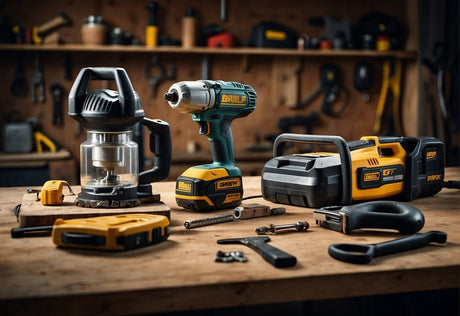


A complete guide to choosing your professional abrasive products
What is an abrasive product and why does particle size determine your final result?
Professional abrasives like Norton Saint-Gobain incorporate anti-clogging treatments that extend their lifespan by up to 40% compared to consumer versions.
For Quebec mechanics, understanding this scale transforms every project: too aggressive a grit creates irreversible scratches, while too fine a grit unnecessarily lengthens the process. Investing in industrial-grade abrasives reduces labor time by 25-35%, according to shop floor productivity studies.
What are the technical differences between grinding wheels, discs and abrasive files for mechanical applications?
Each format meets specific requirements: vitrified bond grinding wheels withstand temperatures up to 1200°C for intensive grinding, flexible fiber-vulcanized discs conform to irregular contours, and single or double-sided files (bastard, half-round) offer irreplaceable tactile control. Professional mechanics combine these three technologies to cover 90% of workshop needs without compromising quality.
Ceramic and zirconia technologies: how do next-generation abrasives increase productivity?
Zirconia (zirconium oxide) offers superior toughness for stainless steel and difficult alloys, maintaining its aggressiveness under high pressure where other grains dull. Makita incorporates these technologies into its professional combination abrasive kits.
For high-volume Quebec workshops, the initial investment, 30-40% higher, pays for itself in 2-3 months thanks to reduced consumables and increased throughput. High-temperature applications (welding, forging) particularly benefit from the thermal stability of ceramics up to 1400°C.
How to optimize the use of abrasive products for your automotive and industrial mechanical applications?
In industrial mechanics, 60-grit grinding wheels grind tools and dies, while flap discs (a combination of overlapping abrasive layers) provide a smooth, progressive finish without transition marks on steel and aluminum. Precision files sharpen saws, adjust machined parts, and create tight fits impossible with rotary tools.
An efficient machinist selects their abrasive based on three criteria: the material being treated (ferrous/non-ferrous), the required material removal rate (mm³/min), and the desired finish (Ra 0.4–6.3 μm). This methodical approach reduces rework and ensures professional quality.
Ergonomics and compatibility: how to assemble your professional abrasive ecosystem?
Auxiliary handles reduce vibrations (5-15 m/s²) and improve control during extended use. For multi-user workshops in Quebec, create dedicated workstations: a bench grinder with various grit sizes, a portable station with cutting/deburring discs, and a workbench equipped with files and hand stones.
Magnetic holders and wall organizers keep abrasives sorted by type/grit, eliminating search time. Invest in quality protection: face shields, adequate ventilation (air exchange 6-12 times per hour), and dry storage areas (humidity <50%) maintain abrasive performance and operator safety in accordance with Canadian CNESST standards.