

 Sold out
 Sold out


Our recommendations
-

Milwaukee
Milwaukee 2745-20 M18 30 Degree Framing Nailer (Tool Only)
Regular price CA$598.00Unit price /UnavailableVery low stock (1 unit) -

Makita
18V LXT Framing Nailer (Tool Only) Makita DBN901ZK
Regular price CA$679.00Unit price /UnavailableLow stock (4 units) -


Dewalt
DEWALT DWMC150 PNEUMATIC SHIFT NAILER
Regular price CA$399.00Unit price /UnavailableVery low stock (2 units) -

 Sale
SaleDewalt
Heavy-Duty 1/4" Staples (5000) DEWALT DWHTTA7045
Sale price CA$14.42 Regular price CA$15.73Unit price /UnavailableIn stock (15 units) -

Dewalt
Regular price CA$359.00Unit price /UnavailableLow stock (6 units) -
 Sold out
 -
 Sold out
 -

Jacobs Chuck
Regular price CA$16.51Unit price /UnavailableVery low stock (2 units) -

Jacobs Chuck
JACOB K3 CHUCK KEY JCM13700P20
Regular price CA$14.07Unit price /UnavailableIn stock (12 units) -
 Sold out
 -

Dewalt
20V BRUSHLESS 4-1/2 - 5 IN GRINDER
Regular price CA$258.00Unit price /UnavailableVery low stock (2 units) -

Chicago pneumatic
Regular price CA$127.45Unit price /UnavailableIn stock (37 units) -

Dewalt
4-1/2-5'' VARIABLE SPEED GRINDER (TOOL ONLY)
Regular price CA$379.00Unit price /UnavailableLow stock (5 units) -

 Sale
SaleMilwaukee
Milwaukee M18 FUEL Cordless Angle Grinder 4-1/2 in / 5 in 2881-20
Sale price CA$283.67 Regular price CA$298.00Unit price /UnavailableVery low stock (2 units)


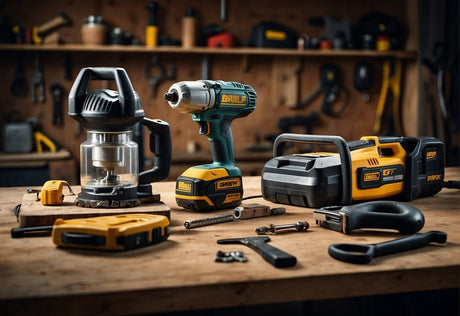


A complete guide to choosing your professional pneumatic accessories
What makes JET pneumatic accessories essential for Quebec workshops?
JET pneumatic accessories form the nervous system of any professional compressed air system. They comprise all the connection, regulation, filtration, and distribution components that transform the raw pressure from a compressor (typically 90-150 PSI) into controlled working power tailored to each tool.
A professional pneumatic system includes quick couplers (allowing tool changes in less than 2 seconds), threaded fittings (NPTF ¼" to 1" depending on the required flow rate), pressure regulators (adjustable from 0 to 160 PSI with an accuracy of ±2%), coalescing filters (removing 99.97% of particles down to 0.01 micron), and automatic lubricators (dosing 1 to 3 drops of oil per minute depending on the air flow).
In Quebec's conditions, where temperature fluctuations cause condensation, these accessories protect your tools from internal corrosion and maintain consistent performance. A properly equipped workshop can see its productivity increase by 30% simply by eliminating downtime for connections.
A professional pneumatic system includes quick couplers (allowing tool changes in less than 2 seconds), threaded fittings (NPTF ¼" to 1" depending on the required flow rate), pressure regulators (adjustable from 0 to 160 PSI with an accuracy of ±2%), coalescing filters (removing 99.97% of particles down to 0.01 micron), and automatic lubricators (dosing 1 to 3 drops of oil per minute depending on the air flow).
In Quebec's conditions, where temperature fluctuations cause condensation, these accessories protect your tools from internal corrosion and maintain consistent performance. A properly equipped workshop can see its productivity increase by 30% simply by eliminating downtime for connections.
What technical specifications determine the compatibility of pneumatic fittings?
The compatibility of accessories for pneumatic tools is based on three critical measurable parameters. The nominal diameter of the air passage (¼", ⅜", ½", ¾", 1") determines the maximum flow rate: a ¼" (6.35mm) fitting delivers up to 25 SCFM (cubic feet per minute), while a ½" (12.7mm) can reach 80 SCFM without significant pressure loss.
The standardized threading uses the NPT (National Pipe Thread) standard in the United States and Canada, with specific thread pitches: NPT 1/8" (27 threads/inch), NPT 1/4" (18 threads/inch), NPT ⅜" (18 threads/inch), and NPT 1/2" (14 threads/inch). JET fittings utilize the NPTF (National Pipe Thread Fuel) system, which creates a leak-proof metal-to-metal seal without the need for Teflon tape.
The maximum rated pressure varies depending on the construction: chrome brass fittings support up to 300 PSI, stainless steel versions reach 500 PSI, while anodized aluminum couplers are limited to 150 PSI but offer a 40% weight reduction for portable applications.
The standardized threading uses the NPT (National Pipe Thread) standard in the United States and Canada, with specific thread pitches: NPT 1/8" (27 threads/inch), NPT 1/4" (18 threads/inch), NPT ⅜" (18 threads/inch), and NPT 1/2" (14 threads/inch). JET fittings utilize the NPTF (National Pipe Thread Fuel) system, which creates a leak-proof metal-to-metal seal without the need for Teflon tape.
The maximum rated pressure varies depending on the construction: chrome brass fittings support up to 300 PSI, stainless steel versions reach 500 PSI, while anodized aluminum couplers are limited to 150 PSI but offer a 40% weight reduction for portable applications.
Technological innovations in professional quick coupling systems
JET professional pneumatic fittings incorporate advanced locking technologies that eliminate accidental disconnections under load. The ColorConnex system uses color codes to instantly identify sizes (red = 1/4", yellow = 1/8", blue = 1/2") and prevents connection errors that cause 15% of tool failures according to industry data.
The double-valve, leak-proof couplers maintain line pressure even after disconnection, saving up to 2 minutes of repressurization time per tool change. This bi-directional technology simultaneously closes the male and female ends, capturing air in both directions with a residual loss of less than 0.5 PSI.
Digital regulators with LED displays replace traditional analog pressure gauges, offering ±0.5% accuracy across the entire 0-200 PSI range. Their 0.3-second response to demand changes maintains consistent pressure even when three tools are operating simultaneously on the same line. JET also offers filters with visual saturation indicators that change color (green to red) when replacement is necessary.
The double-valve, leak-proof couplers maintain line pressure even after disconnection, saving up to 2 minutes of repressurization time per tool change. This bi-directional technology simultaneously closes the male and female ends, capturing air in both directions with a residual loss of less than 0.5 PSI.
Digital regulators with LED displays replace traditional analog pressure gauges, offering ±0.5% accuracy across the entire 0-200 PSI range. Their 0.3-second response to demand changes maintains consistent pressure even when three tools are operating simultaneously on the same line. JET also offers filters with visual saturation indicators that change color (green to red) when replacement is necessary.
How to optimize pneumatic performance in a multi-station workshop?
The architecture of a professional pneumatic system requires planning of the cumulative flow rate and permissible pressure drop. For a typical automotive repair shop with 4 workstations, calculate: impact wrench (12 SCFM at 90 PSI) + orbital sander (6 SCFM at 90 PSI) + paint gun (10 SCFM at 40 PSI) + air blow gun (4 SCFM at 90 PSI) = 32 SCFM of simultaneous demand.
Y-fittings and multi-outlet manifolds distribute this pressure while maintaining sufficient diameter: use a 1" main line to feed 1/2" secondary branches, never the other way around. Each reduction in diameter creates a restriction that can reduce pressure by 10-15 PSI over a distance of 15 meters.
Install local regulators at each workstation to adapt the pressure to specific needs: 90 PSI for impact tools, 60-70 PSI for nail guns, and 25-30 PSI for HVLP spray guns. This cascading approach protects sensitive tools from overpressure and reduces energy consumption by 20%. Isolation valves at each branch allow for sectional maintenance without shutting down the entire shop floor.
Y-fittings and multi-outlet manifolds distribute this pressure while maintaining sufficient diameter: use a 1" main line to feed 1/2" secondary branches, never the other way around. Each reduction in diameter creates a restriction that can reduce pressure by 10-15 PSI over a distance of 15 meters.
Install local regulators at each workstation to adapt the pressure to specific needs: 90 PSI for impact tools, 60-70 PSI for nail guns, and 25-30 PSI for HVLP spray guns. This cascading approach protects sensitive tools from overpressure and reduces energy consumption by 20%. Isolation valves at each branch allow for sectional maintenance without shutting down the entire shop floor.
Ergonomic connections and universal compatibility of JET accessories
JET pneumatic fittings and couplers adopt the universal industry standard that guarantees interoperability with 95% of pneumatic tools sold in North America. The Industrial Interchange profile (also known as Type I/M or Milton) ensures connection with leading brands while maintaining a ball locking mechanism that withstands 150 lbs of pull-out force.
Ergonomic handling is crucial when making 50+ connections daily: swivel sleeve couplers (360° rotation) eliminate hose twisting, which causes 40% of premature breaks. The sleeve's non-slip, ribbed texture allows for handling with oily work gloves, while the reduced activation force (8 lbs vs. 15 lbs for standard models) prevents muscle fatigue.
To complete your system, consider the JET pneumatic accessory kits, which include: 5 quick couplers in various sizes, 10 male fittings with different threads, a regulator with a 0-160 PSI gauge, a 40-micron particulate filter, and 2 conversion adapters. This ecosystem approach ensures that each tool finds its optimal connection. If you're looking to maximize the lifespan of your equipment, you'll also need our inline lubricators, which install between the compressor and the couplers.
Ergonomic handling is crucial when making 50+ connections daily: swivel sleeve couplers (360° rotation) eliminate hose twisting, which causes 40% of premature breaks. The sleeve's non-slip, ribbed texture allows for handling with oily work gloves, while the reduced activation force (8 lbs vs. 15 lbs for standard models) prevents muscle fatigue.
To complete your system, consider the JET pneumatic accessory kits, which include: 5 quick couplers in various sizes, 10 male fittings with different threads, a regulator with a 0-160 PSI gauge, a 40-micron particulate filter, and 2 conversion adapters. This ecosystem approach ensures that each tool finds its optimal connection. If you're looking to maximize the lifespan of your equipment, you'll also need our inline lubricators, which install between the compressor and the couplers.