

Lisle
Regular price CA$12.24Unit price /UnavailableLow stock (5 units)
Lang
25-Blade Feeler Gauge, 12 in. Long
Regular price CA$55.25Unit price /UnavailableLow stock (4 units) Sale
SaleInsize
TELESCOPIC GAUGE KIT 6PCS INSIZE
Sale price CA$63.67 Regular price CA$65.95Unit price /UnavailableLow stock (4 units) Sale
SaleACCUSIZE
ACCUSIZE EG02-5011 5/16-6" Telescopic Gauge Set
Sale price CA$42.50 Regular price CA$46.36Unit price /UnavailableLow stock (6 units)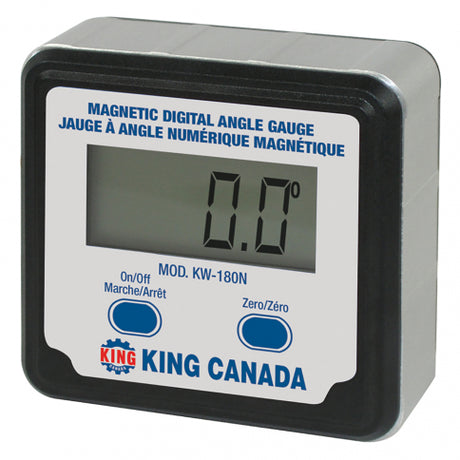
King Canada
Regular price CA$56.65Unit price /UnavailableLow stock (4 units)


Our recommendations
-
 BestsellerSold out
Stanley
PACK OF 2 FATMAX 8M/26 STANLEY FATMAX RIBBON LINE FMHT74226
Regular price CA$76.90Unit price /Unavailable -

Lufkin
MEASURING TAPE 1" X 26' LUFKIN
Regular price CA$25.00Unit price /UnavailableIn stock (17 units) -

Starrett
MEASURING TAPE 1" X 8M STARRETT EXACT TX1-26ME
Regular price CA$30.25Unit price /UnavailableIn stock (16 units) -

Tajima
MEASURING TAPE WITH BELT HOLDER 16'
Regular price CA$49.02Unit price /UnavailableLow stock (6 units) -
Dewalt
DEWALT DWMC150 PNEUMATIC SHIFT NAILER
Regular price CA$399.00Unit price /UnavailableVery low stock (2 units) -
-
 Sale
SaleACCUSIZE
EXT. MICROMETER 0-1" ACCUSIZE EG00-0001
Sale price CA$51.00 Regular price CA$55.64Unit price /UnavailableVery low stock (1 unit) -
 Sale
SaleACCUSIZE
EXT. MICROMETER 2" TO 3" ACCUSIZE EG00-0003
Sale price CA$60.00 Regular price CA$65.45Unit price /UnavailableVery low stock (1 unit) -
 Sale
SaleACCUSIZE
EXT. MICROMETER 3" TO 4" ACCUSIZE EG00-0004
Sale price CA$65.00 Regular price CA$70.91Unit price /UnavailableVery low stock (1 unit) -

Rocol
ROCOL RTD METAL CUTTING LUBRICANT LIQUID 500 ML. 53072
Regular price CA$41.20Unit price /UnavailableIn stock (17 units) -

Zep
ZEP GRAPHITE DRY LUBRICANT - 18 oz. 16401C
Regular price CA$23.93Unit price /UnavailableLow stock (5 units) -

Noga
MAGNETIC BASE WITH SUPPORT NOGA NF61003
Regular price CA$157.78Unit price /UnavailableVery low stock (1 unit) -

Noga
NOGA MG61003 Articulated Magnetic Base
Regular price CA$248.79Unit price /UnavailableVery low stock (2 units) -
Noga
Regular price CA$196.61Unit price /UnavailableLow stock (9 units) -
-

Noga
NOGA DG6160 Magnetic Stand with Dual Fine Adjustment
Regular price CA$218.37Unit price /UnavailableVery low stock (1 unit)





A complete guide to choosing your professional gauges
What is a precision gauge and why is it essential in your workshop?
Feeler gauges, for example, use calibrated blades of hardened steel to measure gaps between parts, essential for adjusting engine valves, checking bearing clearances, or verifying the alignment of assemblies. In Quebec, where metric and imperial standards coexist, having dual-graduated Starrett or Precision Brand feeler gauges becomes a decisive advantage for any quality-conscious mechanic or technician.
What technical specifications define a high-quality gauge?
The Rockwell hardness of the blades varies between 45-50 HRC for flexibility and 58-62 HRC for maximum rigidity, depending on the application. Dial gauges and comparators offer a resolution of 0.01 mm with a repeatability of ±0.002 mm, crucial for quality control. Look for ISO 9001 certification and NIST traceability to ensure the accuracy of your measurements.
Modern technologies and innovations in measuring instruments
Titanium nitride (TiN) coatings extend the lifespan of thick blades by 300%, particularly in corrosive environments. Precision Brand has developed austenitic stainless steel blade gauges for the Quebec food and pharmaceutical industries.
Noga's telescopic depth gauges use magnetic locking systems, enabling one-handed measurements in confined spaces. Lang offers combination sets where each blade is color-coded for quick identification, reducing selection errors by 40% in production.
In which applications do professional gauges make a difference?
The aerospace industry requires certified gauges to inspect rivets and structural assemblies with tolerances of ±0.05 mm. Industrial electricians measure high-voltage circuit breaker sets with dielectric insulating gauges.
In preventive maintenance, Quebec technicians use laser alignment gauges to detect shaft misalignments before catastrophic failure. Metal fabrication shops employ Starrett combination gauges to simultaneously check angles, depths, and diameters, reducing inspection time by 60%.
How to optimize ergonomics and extend the lifespan of your gauges?
Apply a thin coat of Precision Brand anti-corrosion oil after each use, especially in Quebec's un-air-conditioned workshops where humidity fluctuates. Dial gauges require annual calibration against certified standard blocks to maintain their accuracy – a service offered by several Canadian distributors.
Invest in hard carrying cases for your trips to the job site. Insize digital gauges require SR44 batteries (2000-hour battery life), available locally. Complete your equipment with Arkansas sharpening stones to restore dull edges on thickness gauges—a technique mastered by veterans but still relevant for maximizing your return on investment.