
Équipement Polar
Regular price CA$25.27Unit price /UnavailableIn stock (13 units)
Dewalt
Dewalt - DG5372 - 12 Pocket Suede Carpenter Apron
Regular price CA$89.99Unit price /UnavailableVery low stock (1 unit)
Coast
Regular price CA$61.65Unit price /UnavailableVery low stock (2 units)


Our recommendations
-
 BestsellerSold out
Stanley
PACK OF 2 FATMAX 8M/26 STANLEY FATMAX RIBBON LINE FMHT74226
Regular price CA$76.90Unit price /Unavailable -

Lufkin
MEASURING TAPE 1" X 26' LUFKIN
Regular price CA$25.00Unit price /UnavailableIn stock (30 units) -

Starrett
1"-26" STARRETT EXACT KTX1-26ME-N MEASURING TAPE
Regular price CA$30.25Unit price /UnavailableIn stock (24 units) -

Jet
COB RECHARGEABLE WORK LIGHT ON PIVOTING BASE JET 849858
Regular price CA$28.64Unit price /UnavailableVery low stock (2 units) -


-

Dewalt
Regular price CA$358.00Unit price /UnavailableVery low stock (1 unit) -

Jet
JET 22'' PLASTIC TOOL BOX 842144
Regular price CA$48.97Unit price /UnavailableVery low stock (2 units) -


Dewalt
TOUGHSYSTEM 2.0 3 DRAWER ENCLOSURE
Regular price CA$199.00Unit price /UnavailableIn stock (39 units) -
 Sold out
 -
 Sold out
 -
 Sale
SalePeakworks
PEAKWORKS CLASS A BASIC HARNESS
Sale price CA$65.62 Regular price CA$71.58Unit price /UnavailableLow stock (4 units) -
 Sold out
 -

Honeywell
HARNESS AND FACE SHIELD FOR F4400 SAFETY HELMET
Regular price CA$34.72Unit price /UnavailableLow stock (3 units)


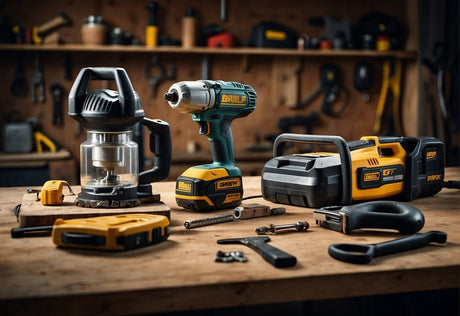


COMPLETE GUIDE
Why invest in a professional pouch and belt system tailored to your profession?
The average Quebec mechanic wastes 53 minutes a day searching for tools. The solution? A system of pouches and belts designed for your reality: harsh winters, cramped workshops, and multiple jobs. Modern work belts are no longer just simple leather straps; they've become portable command centers.
A professional tool belt distributes up to 15 kg of tools across your hips with a carefully designed biomechanical balance, reducing lower back strain by 40% compared to wearing a tool bag. Dewalt and Klein Tools modular tool pouches utilize abrasion-resistant ballistic fabrics (1680 denier) that withstand the oils, solvents, and metal edges you encounter daily in Montreal garages or Laval factories.
A professional tool belt distributes up to 15 kg of tools across your hips with a carefully designed biomechanical balance, reducing lower back strain by 40% compared to wearing a tool bag. Dewalt and Klein Tools modular tool pouches utilize abrasion-resistant ballistic fabrics (1680 denier) that withstand the oils, solvents, and metal edges you encounter daily in Montreal garages or Laval factories.
What technical characteristics differentiate an economical tool belt from a professional model?
Budget belts use 600-denier nylon and aluminum rivets that break after 6-8 months of heavy use. Professional models from Kunys and Makita incorporate full-grain tanned leather (2.5-3mm thick) or 1680-denier ballistic nylon with triple-stitched seams and hardened steel rivets capable of withstanding 180 kg of tension. The difference lies in durability: a Dewalt Professional belt lasts 3-5 years with daily use versus 8-12 months for a consumer version.
Closure systems are also evolving, with quick-release buckles made of fiberglass-reinforced polymer replacing basic metal buckles that rust in Quebec's de-icing salt. Premium pouches offer rigid, thermoformed compartments that maintain their shape even when empty, unlike soft versions that sag and make access difficult.
Closure systems are also evolving, with quick-release buckles made of fiberglass-reinforced polymer replacing basic metal buckles that rust in Quebec's de-icing salt. Premium pouches offer rigid, thermoformed compartments that maintain their shape even when empty, unlike soft versions that sag and make access difficult.
How are innovations in ergonomics and materials transforming modern tool pouches?
Tajima revolutionized the market with low-profile pouches that reduce lateral bulk by 35%, crucial in confined spaces under the hood. Klein Tools now incorporates multi-point suspension systems that distribute weight over 8-12 contact points versus the traditional 4, eliminating pressure points.
Composite materials are gradually replacing leather: Makita's UV-treated Cordura maintains its flexibility at -30°C, essential for Canadian winter construction sites.
The tape measure pouches feature self-aligning magnetic clips that securely hold your Starrett or Tajima tape measure with one hand. Coast's innovative design introduces pouches with integrated, motion-activated LED lighting, allowing you to work in dark environments without a bulky headlamp.
Composite materials are gradually replacing leather: Makita's UV-treated Cordura maintains its flexibility at -30°C, essential for Canadian winter construction sites.
The tape measure pouches feature self-aligning magnetic clips that securely hold your Starrett or Tajima tape measure with one hand. Coast's innovative design introduces pouches with integrated, motion-activated LED lighting, allowing you to work in dark environments without a bulky headlamp.
What performance criteria guarantee that a work belt will withstand your intensive daily activities?
A professional tool belt must support at least 12 kg of tools distributed across 8-10 pouches for 8-12 hours without deformation. Test the belt width: 50 mm minimum for proper load distribution, 75 mm for heavy loads (drills, impact wrenches). Retention capacity matters: Dewalt pouches use adjustable elastic straps that secure screwdrivers and pliers while you bend or climb ladders.
Check the customization options; the modular systems allow you to add or remove pouches depending on the task, switching from a 6-pocket electrician's configuration to a 12-pocket mechanic's configuration. Task and Wipeco belts offer compatibility with Peakworks safety harnesses for working at heights, crucial for CNESST compliance.
Check the customization options; the modular systems allow you to add or remove pouches depending on the task, switching from a 6-pocket electrician's configuration to a 12-pocket mechanic's configuration. Task and Wipeco belts offer compatibility with Peakworks safety harnesses for working at heights, crucial for CNESST compliance.
How to optimize comfort and accessibility with the right pouch and belt accessories?
Comfort is built on three pillars: waist belt width (75mm for full days), breathable padding (perforated memory foam), and load balance.
Position heavy tools (drills, grinders) behind your hips to balance your body weight. Ambidextrous pouches allow you to access tools with either hand without contorting yourself.
Invest in suspension straps for loads exceeding 10 kg; they transfer 60% of the weight to your shoulders. Universal belt clips accommodate Coast lights, lasers, and phones.
To maximize your ecosystem, combine the main belt with detachable specialized pouches: an electrician's pouch for testers, a precision pouch for small components, and a waterproof pouch for humid environments. Quebec mechanics appreciate models with insulated pockets that protect lithium-ion batteries from extreme cold.
Position heavy tools (drills, grinders) behind your hips to balance your body weight. Ambidextrous pouches allow you to access tools with either hand without contorting yourself.
Invest in suspension straps for loads exceeding 10 kg; they transfer 60% of the weight to your shoulders. Universal belt clips accommodate Coast lights, lasers, and phones.
To maximize your ecosystem, combine the main belt with detachable specialized pouches: an electrician's pouch for testers, a precision pouch for small components, and a waterproof pouch for humid environments. Quebec mechanics appreciate models with insulated pockets that protect lithium-ion batteries from extreme cold.