

A welding helmet protects your eyes, face and neck from the arc, sparks and spatter. The Canadian Centre for Occupational Health and Safety publishes a fact sheet on welding protective equipment, including how to choose the lens.
We ranked 10 models from our welding helmet collection, from a $39 passive helmet to the $689 Lincoln Viking 3350 ADV.
In this guide:
- The 10 models, from least to most expensive, with their features
- A table to compare them quickly
- How to choose: passive or auto-darkening, shade, sensors, viewing area
- Answers to the most common questions
Our quick picks for welding helmets
- Tight budget, passive helmet → Lincoln K2800-1 : $39
- First auto-darkening helmet → Sellstrom S26200 : $183.30
- Regular shop use → Lincoln Viking 1740 : $234
- Full-time welder → Sellstrom S26400 : $309
- Optics and large window → Lincoln Viking 3350 : $529
- The most features → Lincoln Viking 3350 ADV : $689
Comparison table
| Model | Type | Shade | Key feature | Best for | Price |
|---|---|---|---|---|---|
| Lincoln K2800-1 | Passive | Fixed 10 | 4.50 x 5.25 in viewing area | Spare, occasional use | $39 |
| Honeywell Tigerhood | Flip front | Fixed lens | Protects the throat, fits over a respirator | Job site, with a respirator | $108.30 |
| Sellstrom S26100 | Auto-darkening | 9 to 13 | 2 arc sensors, solar | Light-duty use | $109.90 |
| Sellstrom S26200 | Auto-darkening | 9 to 13 | 4 arc sensors, battery or solar | First serious helmet | $183.30 |
| Lincoln Viking 1740 | Auto-darkening | Variable | Large viewing area, Viking series | Shop, regular use | $234 |
| Jackson Halo X | Auto-darkening | 9 to 13 | 3.93 x 2.36 in window, 4 sensors | Wide window, moderate price | $289 |
| Sellstrom S26400 | Auto-darkening | Adjustable | Blue Lens, settings memory | Full-time welder | $309 |
| Lincoln Viking 2450 | Auto-darkening | 5 to 13 | 4C lens, 1/1/1/1 clarity | High-end optics | $479 |
| Lincoln Viking 3350 | Auto-darkening | 5 to 13 | 12.5 sq in, 1/25,000 s switching | Optics and large window | $529 |
| Lincoln Viking 3350 ADV | Auto-darkening | Adjustable | Bluetooth, advanced controls | Maximum features | $689 |
See every model in our welding helmet collection. Free shipping on orders of $150 or more.
1. Lincoln Electric K2800-1 Passive Shade 10
The most affordable passive helmet

Passive, fixed shade 10
4.50 x 5.25 in
18.7 oz (530 g)
Stick, TIG, MIG, flux-cored, gouging
Headgear and oversized absorbent sweatband
$39
The Lincoln Electric K2800-1 is a passive helmet. Its lens stays dark at a fixed shade 10. There is no battery and no sensor. It costs $39.
The viewing area is large at 4.50 x 5.25 in, and the helmet weighs 18.7 oz. The oversized absorbent sweatband helps through long days. The manufacturer rates it for stick, TIG, pulsed TIG, MIG, pulsed MIG, flux-cored and gouging.
Pros
- $39 price, no battery to manage
- 4.50 x 5.25 in viewing area
- Lightweight at 18.7 oz
- Works with the main welding processes
Things to consider
- Fixed shade: you have to flip the helmet up between welds
- No grind mode and no sensitivity setting
Best for: A spare helmet for the shop, an apprentice or occasional use.
Not ideal for: Frequent welding. Step up to an auto-darkening model like the Sellstrom S26100.
Price: $39
See the Lincoln K2800-1 at Équipement Polar →2. Honeywell Tigerhood Classic 5906GY
The flip-front helmet that protects the throat

Flip front
2 x 4-1/4 in
Noryl
3-C free-floating
Multi-position headband, 4-position eyewear support
$108.30
The Honeywell Tigerhood Classic is a flip-front helmet made of Noryl. Its shell shape protects against sparks and spatter. It also protects against fumes and vapours, and extends coverage down to the throat.
It fits easily over safety glasses and respirators. The 3-C free-floating headgear, the multi-position headband and the 4-position eyewear support allow a precise fit. Three mounting options for protective hoods are available.
Pros
- Protects the throat, fumes and vapours
- Fits over safety glasses and respirators
- Flip front: the lens lifts without taking the helmet off
- Adjustable headgear and eyewear support
Things to consider
- No auto-darkening filter
- 2 x 4-1/4 in window, more compact than the lenses on auto-darkening models
Best for: Job-site welding with a respirator or safety glasses.
Not ideal for: Production welding with many arc starts. Look at the Sellstrom S26200 instead.
Price: $108.30
See the Honeywell Tigerhood at Équipement Polar →3. Sellstrom S26100 Advantage Series
The affordable first auto-darkening helmet

9 to 13
3.54 x 1.57 in
2
3 positions (L/M/H)
3 positions (S/M/F)
Solar
$109.90
The Sellstrom S26100 opens the auto-darkening range at $109.90. The lens switches from clear to dark at arc start, with a shade of 9 to 13 and two arc sensors. The viewing area measures 3.54 x 1.57 in.
Sensitivity and delay each adjust across three positions. The helmet runs on solar power, has a grind mode and meets ANSI Z87.1 and CAN/CSA-Z94.3. Sellstrom positions it for light-duty use: experienced DIYers, part-time workers, construction sites and auto shops.
Pros
- Auto-darkening for under $110
- Grind mode included
- Sensitivity and delay adjustable in three positions
- Solar power, no battery to replace
Things to consider
- Only two arc sensors, the S26200 has four
- 3.54 x 1.57 in viewing area, the most compact of the auto-darkening models on the list
- Built for light-duty use
Best for: The experienced DIYer and the shop that welds a few hours a week.
Not ideal for: Daily welding. Move up to the Sellstrom S26200.
Price: $109.90
See the Sellstrom S26100 at Équipement Polar →4. Sellstrom S26200 Advantage Plus Series
Our pick for a first serious auto-darkening helmet

9 to 13
4
Enlarged
Battery or solar
Weld and grind, with grind indicator
ANSI Z87.1 and CAN/CSA-Z94.3
$183.30
The Sellstrom S26200 steps up to four arc sensors and an enlarged viewing area, useful in awkward work angles. The shade runs from 9 to 13. Sensitivity and delay are adjusted inside the helmet, away from knocks.
It runs on batteries or solar power and shows a low-battery warning. The grind mode has an indicator light. Sellstrom positions it for medium-duty work: auto shops, construction sites and steel structures, part-time or full-time.
Pros
- Four arc sensors for reliable darkening
- Internal controls, so they are protected
- Low-battery warning and grind indicator
- Runs on batteries or solar power
Things to consider
- No Blue Lens and no memory function like the S26400
- Built for medium-duty work
Best for: A first auto-darkening helmet for welding several times a week.
Not ideal for: The full-time welder who wants digital controls. Look at the Sellstrom S26400.
Price: $183.30
See the Sellstrom S26200 at Équipement Polar →5. Lincoln Viking 1740 K3282-3
The entry point to the Viking series

Viking 1740
Auto-darkening, variable shade
Large
Sensitivity and delay
Impact and spatter resistant
MIG, TIG, stick, plasma
$234
The Lincoln Viking 1740 K3282-3 is an auto-darkening helmet with variable shade and a large viewing area. The shell resists impacts and spatter. The headgear is adjustable for a secure fit.
Sensitivity and delay settings stay simple. Lincoln positions it for professional welders doing MIG, TIG, stick and plasma over long sessions. At $234, it gets you into the Viking series at a lower price than the 2450 and 3350 models, which add the 4C lens.
Pros
- Variable shade suited to different processes
- Large viewing area
- Impact and spatter resistant shell
- Adjustable headgear and simple settings
Things to consider
- Fewer advanced features than the Viking 2450 and 3350 (4C lens, 1/1/1/1 clarity)
Best for: The shop that welds regularly and wants a Viking helmet at a moderate price.
Not ideal for: The welder who wants 4C optics. Look at the Lincoln Viking 2450.
Price: $234
See the Lincoln Viking 1740 at Équipement Polar →Need advice choosing your welding helmet?
Tell us your process and how many hours a week you weld. Our team will point you to the right model.
See all welding helmets Contact our experts6. Jackson Safety Halo X Black
The wide window at a moderate price

Variable, 9 to 13
3.93 x 2.36 in
4, independent
Digital, sensitivity and delay
Weld and grind
ANSI Z87.1 and CSA
$289
The Jackson Safety Halo X offers a 3.93 x 2.36 in window, 1.5 times the height of the Sellstrom S26100. The W40 INSIGHT filter has a variable shade of 9 to 13 and four independent arc sensors. Controls are digital.
It lets you choose between weld and grind modes, for TIG, MIG and stick. The filter is compatible with the HLX100 and HSL 100 shells. The helmet meets ANSI Z87.1 and CSA standards, in black nylon, one size.
Pros
- 3.93 x 2.36 in window
- Four independent arc sensors
- Easy-to-use digital controls
- Filter compatible with HLX100 and HSL 100 shells
Things to consider
- One size only
- No memory function and no Blue Lens like on the S26400
Best for: The welder who wants a wide view without going past $300.
Not ideal for: The welder who wants stored settings. Look at the Sellstrom S26400.
Price: $289
See the Jackson Halo X at Équipement Polar →7. Sellstrom S26400 Premium Series
Our pick for the full-time welder

Blue Lens, true color
4
Digital: shade, sensitivity, delay, weld/grind
Stores your settings
Solar and battery
ANSI Z87.1 and CAN/CSA Z94.3
$309
The Sellstrom S26400 is the Premium series helmet. Its Blue Lens technology renders true colors. Four arc sensors reduce eye fatigue. Controls are fully digital: shade, sensitivity, delay and weld or grind mode.
The memory stores your shade, sensitivity and delay settings. All controls are internal. The helmet runs on solar power and batteries, with a low-battery warning. Sellstrom positions it for the full-time welder: steel erection, shipbuilding, pipelines and refineries.
Pros
- Blue Lens, true color
- Digital controls and settings memory
- Four arc sensors
- Designed for use with a cartridge respirator
Things to consider
- $309 price, $125.70 more than the S26200
- Features you do not need for occasional use
Best for: The tradesperson who spends the whole day under the helmet.
Not ideal for: Occasional use. The Sellstrom S26200 is enough.
Price: $309
See the Sellstrom S26400 at Équipement Polar →8. Lincoln Viking 2450 Black
4C optics at a moderate price

4C
1/1/1/1
60 cm² (9.3 sq in)
5 to 13
X6
Low-profile external control
$479
The Lincoln Viking 2450 brings the 4C lens and 1/1/1/1 optical clarity. The viewing area reaches 60 cm², or 9.3 sq in. The shade runs from 5 to 13, which covers both welding and cutting.
The X6 headgear spreads the weight to last all day. A low-profile external control switches to grind mode without taking the helmet off. Lincoln lists performance tuned for all welding and cutting processes.
Pros
- 4C lens and 1/1/1/1 optical clarity
- 9.3 sq in viewing area
- Shade 5 to 13, welding and cutting
- X6 headgear and external grind control
Things to consider
- 9.3 sq in viewing area, versus 12.5 sq in on the Viking 3350
- $479 price
Best for: The tradesperson who wants high-end optics without paying for the 3350.
Not ideal for: The welder who wants the largest window. Look at the Lincoln Viking 3350.
Price: $479
See the Lincoln Viking 2450 at Équipement Polar →9. Lincoln Viking 3350 Black K3034-4
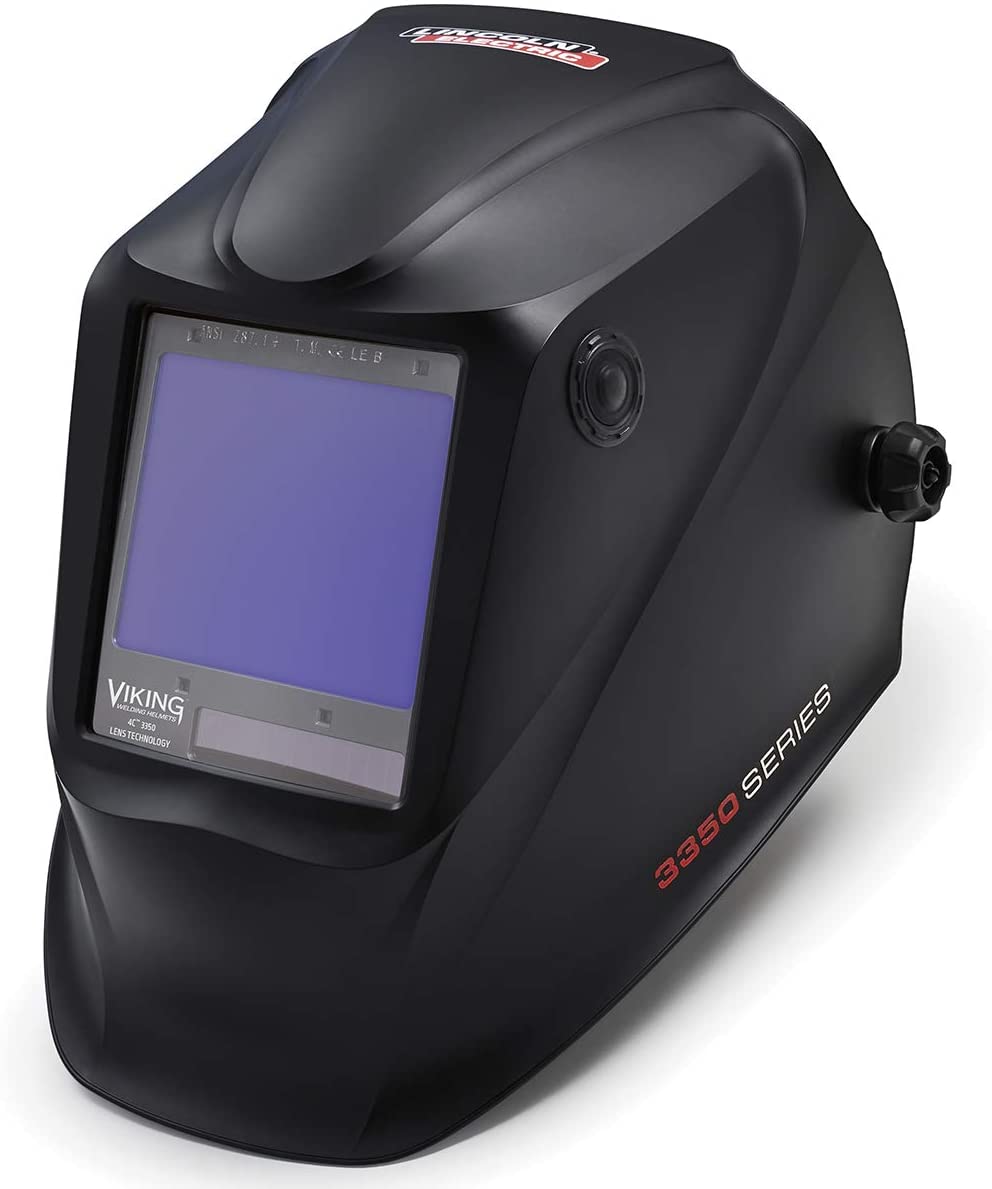
Our pick for optics and window size
1/1/1/1
5 to 13
9.5 x 8.5 cm (12.5 sq in)
1/25,000 s
4
Weld, cut, grind
CR2450 battery and solar cell
ANSI Z87.1, CSA Z94.3, EN379
The Lincoln Viking 3350 (fourth generation) combines the 4C lens, 1/1/1/1 optical clarity and a 12.5 sq in viewing area. The filter switches in 1/25,000 s, thanks to four arc sensors. The shade runs from 5 to 13, with weld, cut and grind modes.
The X6 headgear creates six contact points to spread the weight. A low-profile external grind button saves time. The helmet is compatible with a hard hat and with cheater lenses. It ships with a bag, a bandana, five cover lenses, two inner lenses and a sticker sheet.
Pros
- 1/1/1/1 optical clarity and 4C lens
- 12.5 sq in viewing area
- 1/25,000 s switching, four arc sensors
- Ships with a bag, bandana and spare lenses
Things to consider
- $529 price
- Graphic finishes in the 3350 series cost more, from $649 to $789
Best for: The tradesperson who wants 1/1/1/1 optics and a large 12.5 sq in window.
Not ideal for: A tight budget. The Jackson Halo X costs $240 less.
Price: $529
See the Lincoln Viking 3350 at Équipement Polar →10. Lincoln Viking 3350 ADV Black K3034-5
The most feature-rich helmet on the list

4C
X6
Advanced digital
Modular work-piece lighting
Bluetooth
Bandana, bag, stickers, 5 outer lenses, 2 inner lenses
$689
The Lincoln Viking 3350 ADV takes the series further. It pairs 4C optics and the X6 headgear with advanced digital controls, modular work-piece lighting, automatic shading technology and Bluetooth connectivity.
The helmet ships with a bandana, a drawstring protective bag, a sticker sheet, five KP2898-1 outer protective lenses and two KP5244-1 inner lenses. It is the model on the list that goes furthest on features.
Pros
- Advanced digital controls
- Modular work-piece lighting
- Bluetooth connectivity
- Spare lenses included
Things to consider
- $689 price, $160 more than the standard Viking 3350
- Features that are hard to justify if you weld little
Best for: The shop or welder who wants the maximum number of features in a single helmet.
Not ideal for: The welder who mainly wants the optics. The Lincoln Viking 3350 is enough.
Price: $689
See the Lincoln Viking 3350 ADV at Équipement Polar →How to choose your welding helmet
Passive or auto-darkening
A passive helmet has a fixed-shade lens. The Lincoln K2800-1, for example, stays at shade 10. You flip it up between welds, then lower it before striking the arc.
An auto-darkening helmet goes from clear to dark when the arc starts. Both hands stay free and you weld without lifting the helmet. Eight of the ten models in this guide work that way, and it is the logical choice once you weld several times a week.
Shade
Shade measures how dark the lens is. The 9 to 13 range on the Sellstrom S26100, Sellstrom S26200 and Jackson Halo X suits MIG, TIG and stick welding. The Lincoln Viking 2450 and Lincoln Viking 3350 run from 5 to 13 and also go down to the shade used for cutting.
The right shade depends on the process and the current. Check the manufacturer's chart or the CCOHS fact sheet before setting your helmet.
Arc sensors and switching speed
Sensors detect the arc and trigger the darkening. The Sellstrom S26100 has 2. The Sellstrom S26200, Jackson Halo X, Sellstrom S26400 and Lincoln Viking 3350 have 4. More sensors mean more reliable darkening when the workpiece hides part of the arc.
Switching speed matters too. The Lincoln Viking 3350 goes dark in 1/25,000 of a second.
Viewing area and optical clarity
The viewing area ranges from 3.54 x 1.57 in on the Sellstrom S26100 to 12.5 sq in on the Lincoln Viking 3350. A large window helps in awkward welding positions.
Optical clarity is rated with four numbers: blur, distortion, shade consistency and uniformity across angles. The Lincoln Viking 2450 and Lincoln Viking 3350 are rated 1/1/1/1, the top score.
Comfort, standards and compatibility
A helmet is worn for hours. The X6 headgear on the Viking models creates six contact points to spread the weight. The Lincoln K2800-1 weighs 18.7 oz. The 3-C headgear on the Honeywell Tigerhood and the ratchet adjustment on the Sellstrom models allow a precise fit.
Also check the standards: ANSI Z87.1 and CAN/CSA-Z94.3 on the Sellstrom models and the Jackson Halo X, EN379 on the Lincoln Viking 3350. If you wear a hard hat or a respirator, confirm compatibility before you buy.
Protective lenses and spare parts
Protective lenses wear out with spatter. Plan for spares: our welding helmet collection includes outer and inner lenses, headgear and hard hat adapters. The Lincoln Viking 3350 ships with five cover lenses and two inner lenses.
Budget: which helmet at which price
- Under $120: Lincoln K2800-1 ($39), Honeywell Tigerhood ($108.30), Sellstrom S26100 ($109.90)
- $120 to $300: Sellstrom S26200 ($183.30), Lincoln Viking 1740 ($234), Jackson Halo X ($289)
- $300 to $500: Sellstrom S26400 ($309), Lincoln Viking 2450 ($479)
- $500 and up: Lincoln Viking 3350 ($529), Lincoln Viking 3350 ADV ($689)
Completing your gear
A helmet is not enough. Add welding gloves and welding protection. If you also need the machine, see our welders.
Ready to choose your welding helmet?
Browse our in-stock welding helmets or ask our team for advice. Free shipping on orders of $150 or more.
See the welding helmet collection Contact our expertsFAQ: welding helmets
What is the best welding helmet for beginners?
How do I choose a good welding helmet?
Why wear a welding helmet?
What is the difference between a passive and an auto-darkening helmet?
Which shade should I use for welding?
How can I relieve my eyes after a day of welding?
Can you wear a welding helmet with a hard hat or a respirator?
Conclusion
The right welding helmet depends on how often you weld and on your budget. For occasional use, the Lincoln K2800-1 at $39 is enough.
For regular welding, the Sellstrom S26200 at $183.30 is a good start. For a full day, the Sellstrom S26400 at $309 or the Lincoln Viking 3350 at $529.
Find them all in our welding helmet collection.